
CCE Overview
Find out how CCE 2021 helps students build good character, resilience, and active citizenship through values-based lessons and real-world experiences.
Character and Citizenship Education (CCE), including National Education (NE), and Social and Emotional Learning (SEL), are integral to the holistic development of our students, leading to positive life outcomes. CCE 2021 provides an integrated approach to addressing our students’ development of values, character, social-emotional well-being, and citizenship dispositions in a coherent and holistic way.
CCE 2021 aims to develop in our students:
a) Good character: Have a sound moral compass and a strong sense of right and wrong, think critically and ethically, be discerning in judgment, take responsibility for choices and actions, be caring towards others and strive for excellence;
b) Resilience and social-emotional well-being: Have a balanced sense of self, form healthy relationships, be resilient when faced with challenges, find meaning in life, and have a sense of gratitude and appreciation;
c) Future readiness: Have a sense of purpose in life, develop the dispositions of adaptability and lifelong learning so as to be able to navigate education and career pathways purposefully and take on the challenges of the future, including the world of work and life; and
d) Active citizenship: Develop a strong national identity based on a sense of belonging to the nation, a sense of hope in themselves and the future, an awareness of the reality of Singapore’s vulnerabilities and constraints, and the will to act on improving the lives of others, and building a future for our nation.
CCE curriculum content is based on three overarching ideas, namely (Identity, Relationships and Choices) in six domains, starting with self and extending to the family, school, community, nation and the world. The curriculum frame below shows the Core Values, the 3 Big Ideas and the Expanding Domains in the CCE syllabus.
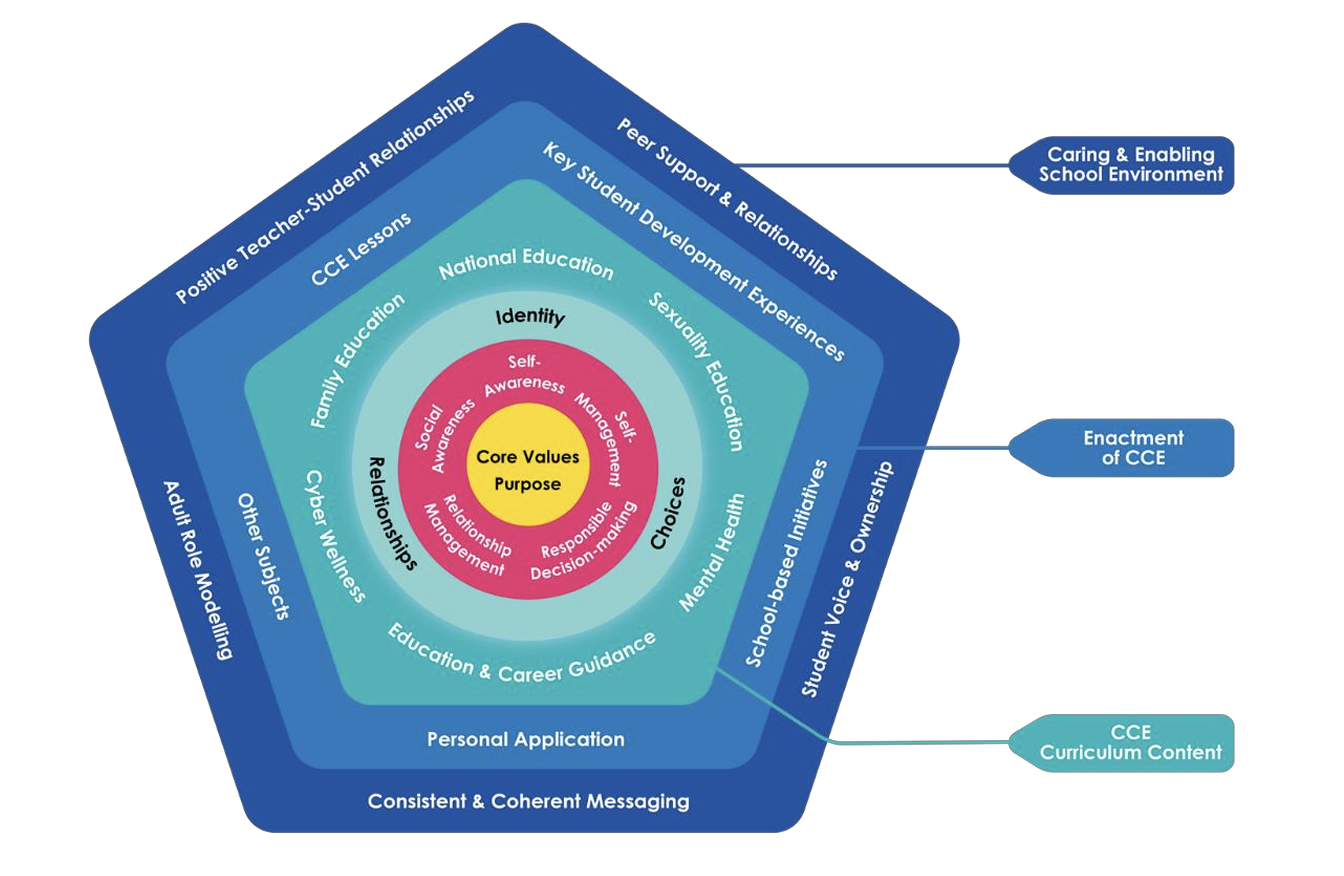
CCE Curriculum Content
CCE Lessons:
Explicit teaching of values and social-emotional skills
Equipping students with knowledge for real-world contexts
Discussions on contemporary issues to elicit multiple perspectives
Key Student Development Experiences (SDEs):
Includes activities such as Co-Curricular Activities, Learning Journeys, Education and Career Guidance, National Education Commemorative Days, NRIC Presentation Ceremony, VIAs and Camps.
These platforms aim to provide a comprehensive and integrated approach to character and citizenship education, blending formal lessons with experiential learning and personal development opportunities.
Approach and Pedagogy
Narrative Approach:
Uses stories to help students understand moral dilemmas
Encourages students to construct and reflect on narratives
Involves open-ended questioning and perspective-taking
Helps students recognise and clarify their values
Explicit Skills Instruction Approach:
Focused on teaching social and emotional skills
Uses scaffolding to guide students through the learning process
Includes clear explanations, demonstrations, and supported practice
Employs role-play as a key strategy for skill development
Experiential Learning Approach:
Based on the idea that knowledge is created through transformed experience
Involves a cycle of experiencing, reflecting, thinking, and acting
Uses concrete experiences like learning journeys and camps
Emphasises learner participation and active testing of concepts
These approaches aim to provide diverse and engaging methods for students to develop character, citizenship, and social-emotional competencies through storytelling, direct instruction, and hands-on experiences.